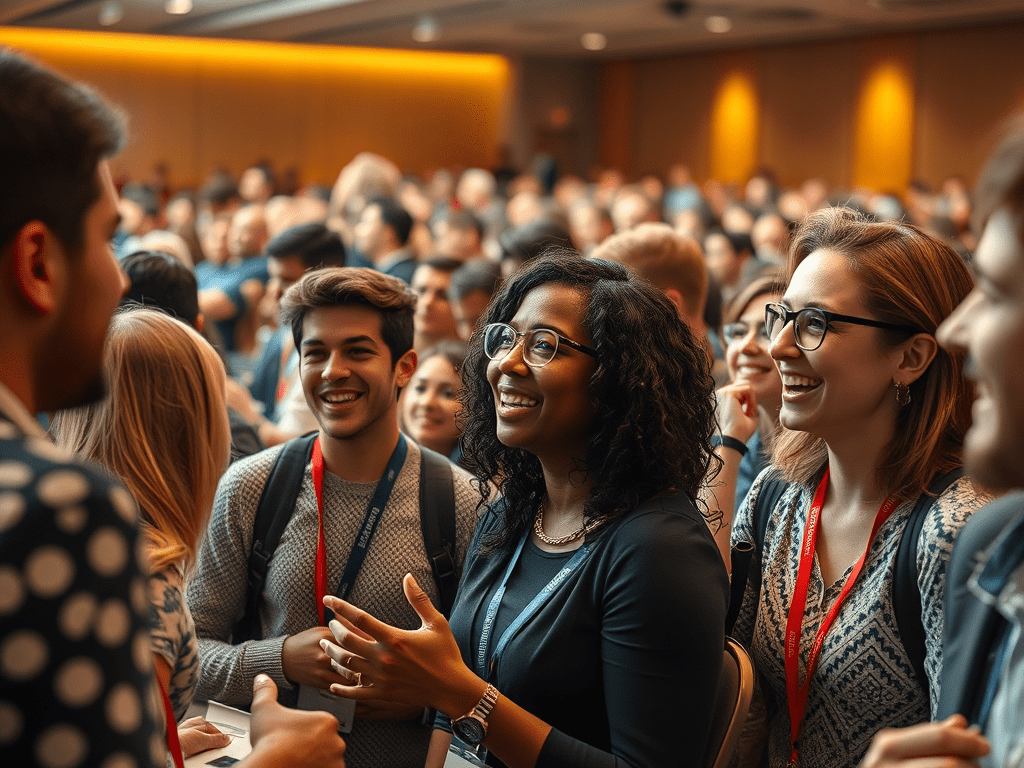
I remember walking into the conference hall on Day 1 of WJMC feeling like my brain had to catch up with my heartbeat. Everything felt electric—there was this humming energy in the air, like the sound of so many voices waiting to be heard. Maybe it was nerves. Maybe it was excitement. Maybe it was both, tangled up together. But one thing was clear from the start: I wasn’t alone in the way I felt about journalism.
That was revolutionary for me.
I’m so used to being the person in the room who talks about media, storytelling, or digital content creation with wide eyes and a hundred unfinished sentences. But this time? I was surrounded by hundreds of people who lit up in the same way. From students who flew in from big cities like New York, to those from the quiet corners of Kansas—everyone had a story, a reason, a fire inside them for this field. And for once, I didn’t have to explain why I cared so much. Everyone just… got it.
So, I made myself a promise that day: Listen more. Speak up anyway. Be curious. Be uncomfortable. I decided to challenge myself—not just to hear the keynote speakers, but to really listen to the people around me. The ones sitting next to me. The ones walking beside me to dinner. The ones whose names I didn’t know yet. I wanted to understand what brought them here. What they hoped to learn. What they dreamed of doing. And let me tell you: these were not surface-level conversations. These were real, raw, beautiful exchanges of passion.
One girl told me she started a podcast about identity and growing up first-gen. Another guy shared how he shoots short films with his cousins in his backyard because his school doesn’t offer a film class. I heard voices crack with vulnerability, and I saw eyes light up with inspiration. We were strangers at breakfast, but storytellers by dinner.
That night, we had our first speaker—Savannah Behrmann, the Senate Correspondent at National Journal. I didn’t know what to expect, but her words hit like a gut punch in the best way. She didn’t just talk about politics or headlines. She talked about people. About the stories that don’t make it into breaking news alerts or front pages. The ones that are often whispered or buried because they’re inconvenient, emotional, or overlooked.
She said, “The most important stories are the ones that are hardest to hear.”
That line hasn’t left me since.
She reminded us that statistics don’t cry. Charts don’t bury their children. Graphs don’t grow up in food deserts or get deported or work two jobs to afford textbooks. People do. And if you’re a journalist who forgets that, you’ve missed the story entirely.
Her message echoed everything I already believed in my gut: that the stories that aren’t told are often the ones that matter most. That sometimes, it’s not the headline that needs to change—it’s who we give the mic to.
After she spoke, the moderator opened the floor for questions. There were 400 of us in that room. I could feel the weight of that number in my chest. The mic stood in the aisle like a spotlight no one wanted to step into. And honestly? I didn’t have a perfect question. I wasn’t even sure I had a question. But I stood up anyway.
I walked to the mic with shaky hands and a racing heart, telling myself the same thing I always do when I’m scared: Just start. You’ll figure it out on the way.
And I did. I spoke. My voice cracked a little, but it was mine. I asked a question—maybe not the most polished one—but it came from a place of genuine curiosity. And that was enough. People clapped. Savannah smiled. I walked back to my seat feeling like I had just jumped off a cliff and landed on solid ground.
That moment mattered. Not because I asked a perfect question. But because I didn’t let fear keep me silent. I let the discomfort be proof that I was doing something bold.
Day 1 at WJMC wasn’t just about journalism. It was about courage. The kind that whispers, Go. Ask. Speak. Be seen. Even when it’s terrifying. Especially then.
And if I learned anything that day, it’s this:
Stories don’t start when we feel ready. They start when we decide to speak—whether we’re in front of 400 strangers or just sittin6g quietly next to someone with a story to tell. The truth waits for no one. So why should we?
Let this be the beginning—not just of a conference, but of a thousand brave questions.
 Starting Narratives
Leave a comment